Rigol MSO5000 Binary Waveform Examples
Scott Prahl
Mar 2026
[1]:
%config InlineBackend.figure_format = 'retina'

import io

import numpy as np
import matplotlib.pyplot as plt
import requests
from RigolWFM import Wfm

repo = "https://raw.githubusercontent.com/scottprahl/RigolWFM/main/tests/files/"


def sample_url(relative_path: str) -> str:
    return repo + relative_path


def _time_scale(times):
    span = float(abs(times[-1] - times[0])) if len(times) > 1 else 1.0
    if span >= 1e-3:
        return 1e3, "ms"
    if span >= 1e-6:
        return 1e6, "us"
    if span >= 1e-9:
        return 1e9, "ns"
    return 1e12, "ps"


def _volt_scale(values):
    peak = max(float(np.max(np.abs(v))) for v in values) if values else 1.0
    if peak >= 1.0:
        return 1.0, "V"
    if peak >= 1e-3:
        return 1e3, "mV"
    if peak >= 1e-6:
        return 1e6, "uV"
    return 1e9, "nV"


def plot_analog_channels(w, title=None, max_points=5000):
    active = [ch for ch in w.channels if ch.times is not None and ch.volts is not None]
    if not active:
        print("No analog channels are enabled in this capture.")
        return

    colors = ["green", "red", "blue", "orange"]
    t_scale, t_unit = _time_scale(active[0].times)
    v_scale, v_unit = _volt_scale([ch.volts for ch in active])

    fig, axes = plt.subplots(len(active), 1, sharex=True, figsize=(10, 2.5 * len(active)))
    if len(active) == 1:
        axes = [axes]

    for ax, ch, color in zip(axes, active, colors):
        stride = max(len(ch.times) // max_points, 1)
        ax.plot(ch.times[::stride] * t_scale, ch.volts[::stride] * v_scale, color=color)
        ax.set_ylabel(v_unit)
        ax.set_title(f"CH{ch.channel_number}  {ch.points} points")
        ax.grid(True)

    axes[-1].set_xlabel(f"Time ({t_unit})")
    if title:
        fig.suptitle(title)
    plt.tight_layout()
    plt.show()


def plot_logic_window(w, names=None, start=0, stop=4000, title=None):
    if not w.logic_channels:
        print("No logic channels are enabled in this capture.")
        return

    if names is None:
        names = list(w.logic_channels)

    if w.logic_times is None:
        times = np.arange(len(next(iter(w.logic_channels.values()))), dtype=np.float64)
    else:
        times = w.logic_times

    stop = min(stop, len(times))
    t_scale, t_unit = _time_scale(times[start:stop])

    fig, axes = plt.subplots(len(names), 1, sharex=True, figsize=(10, 1.6 * len(names)))
    if len(names) == 1:
        axes = [axes]

    colors = ["green", "red", "blue", "orange", "purple", "brown"]
    for ax, name, color in zip(axes, names, colors):
        trace = w.logic_channels[name]
        ax.step(times[start:stop] * t_scale, trace[start:stop], where="post", color=color)
        ax.set_ylim(-0.2, 1.2)
        ax.set_yticks([0, 1])
        ax.set_ylabel(name)
        ax.grid(True)

    axes[-1].set_xlabel(f"Time ({t_unit})")
    if title:
        fig.suptitle(title)
    plt.tight_layout()
    plt.show()


from RigolWFM import DS5000_scopes, MSO5074_scopes
A few accepted model aliases for this family are:
[2]:
print("MSO5000 family aliases:")
print(DS5000_scopes)

print()
print("MSO5074 aliases:")
print(MSO5074_scopes)
MSO5000 family aliases:
['5', '5000', 'MSO5000']

MSO5074 aliases:
['5074', 'MSO5074']
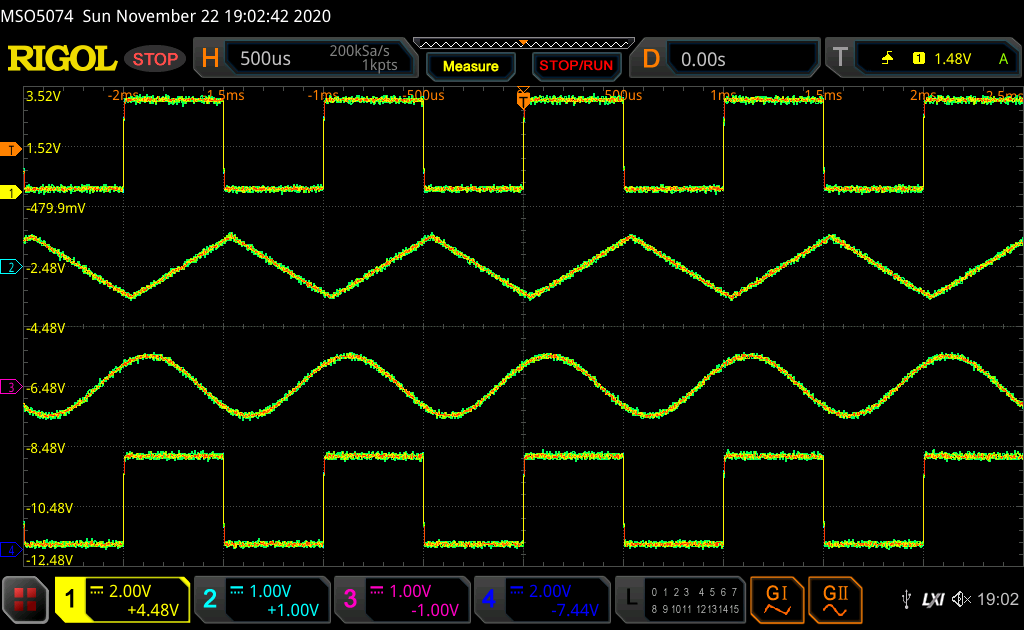
MSO5000-A - Four-channel analog capture
Oscilloscope screenshot
[3]:
filename = "bin/MSO5000-A.bin"
w = Wfm.from_url(sample_url(filename), "5")
print(w.describe())
    General:
        File Model   = MSO5XXX
        User Model   = 5
        Parser Model = bin5000
        Firmware     = 01
        Filename     = MSO5000-A.bin
        Channels     = [1, 2, 3, 4]

    Trigger:
        Derived Level (CH1) = 2.48  V
        Derived Level (CH2) = -439.47 mV
        Derived Level (CH3) = 319.48 mV
        Derived Level (CH4) = 2.37  V

     Channel 1:
         Coupling =  unknown
            Scale =   406.90 mV/div
           Offset =     0.00  V
            Probe =       1X
         Inverted =    False

        Time Base =  500.000 µs/div
           Offset =    0.000  s
            Delta =    5.000 µs/point
           Points =     1000

         Count    = [        1,        2,        3  ...       999,     1000]
           Raw    = [      200,      242,      254  ...        18,       12]
           Times  = [-2.500 ms,-2.495 ms,-2.490 ms  ...  2.490 ms, 2.495 ms]
           Volts  = [697.55 mV,155.01 mV,  0.00  V  ...   3.02  V,  3.10  V]

     Channel 2:
         Coupling =  unknown
            Scale =   134.84 mV/div
           Offset =     0.00  V
            Probe =       1X
         Inverted =    False

        Time Base =  500.000 µs/div
           Offset =    0.000  s
            Delta =    5.000 µs/point
           Points =     1000

         Count    = [        1,        2,        3  ...       999,     1000]
           Raw    = [       28,       19,       19  ...        38,       28]
           Times  = [-2.500 ms,-2.495 ms,-2.490 ms  ...  2.490 ms, 2.495 ms]
           Volts  = [399.52 mV,439.47 mV,439.47 mV  ... 359.57 mV,399.52 mV]

     Channel 3:
         Coupling =  unknown
            Scale =   129.79 mV/div
           Offset =     0.00  V
            Probe =       1X
         Inverted =    False

        Time Base =  500.000 µs/div
           Offset =    0.000  s
            Delta =    5.000 µs/point
           Points =     1000

         Count    = [        1,        2,        3  ...       999,     1000]
           Raw    = [      205,      215,      215  ...       205,      205]
           Times  = [-2.500 ms,-2.495 ms,-2.490 ms  ...  2.490 ms, 2.495 ms]
           Volts  = [-319.48 mV,-359.42 mV,-359.42 mV  ... -319.48 mV,-319.48 mV]

     Channel 4:
         Coupling =  unknown
            Scale =   394.52 mV/div
           Offset =     0.00  V
            Probe =       1X
         Inverted =    False

        Time Base =  500.000 µs/div
           Offset =    0.000  s
            Delta =    5.000 µs/point
           Points =     1000

         Count    = [        1,        2,        3  ...       999,     1000]
           Raw    = [      190,      241,      248  ...         6,        6]
           Times  = [-2.500 ms,-2.495 ms,-2.490 ms  ...  2.490 ms, 2.495 ms]
           Volts  = [789.04 mV,157.81 mV, 78.90 mV  ...   3.08  V,  3.08  V]
downloading 'https://raw.githubusercontent.com/scottprahl/RigolWFM/main/tests/files/bin/MSO5000-A.bin'
Plot all enabled analog channels
[4]:
plot_analog_channels(w, title=filename)

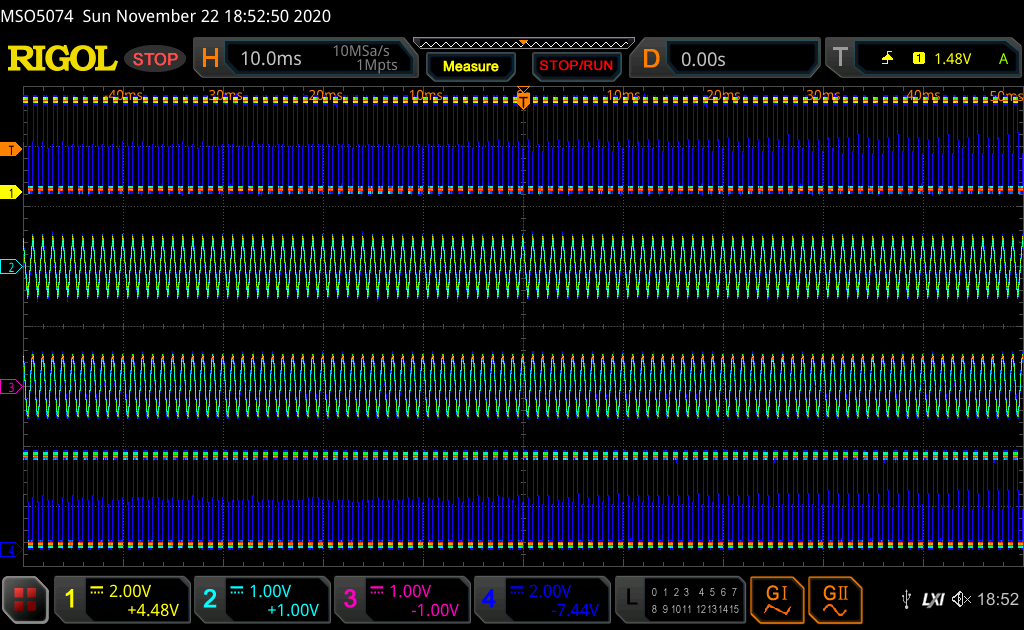
MSO5000-B - Longer analog capture
Oscilloscope screenshot
[5]:
filename = "bin/MSO5000-B.bin"
w = Wfm.from_url(sample_url(filename), "5")
print(w.describe())
downloading 'https://raw.githubusercontent.com/scottprahl/RigolWFM/main/tests/files/bin/MSO5000-B.bin'
    General:
        File Model   = MSO50XX
        User Model   = 5
        Parser Model = bin5000
        Firmware     = 01
        Filename     = MSO5000-B.bin
        Channels     = [1, 2, 3, 4]

    Trigger:
        Derived Level (CH1) = 1.55  V
        Derived Level (CH2) = 439.47 mV
        Derived Level (CH3) = 479.22 mV
        Derived Level (CH4) = 1.58  V

     Channel 1:
         Coupling =  unknown
            Scale =   426.28 mV/div
           Offset =     0.00  V
            Probe =       1X
         Inverted =    False

        Time Base =   10.000 ms/div
           Offset =    0.000  s
            Delta =  100.000 ns/point
           Points =  1000000

         Count    = [        1,        2,        3  ...    999999,  1000000]
           Raw    = [      121,      110,      104  ...       156,      150]
           Times  = [-50.000 ms,-50.000 ms,-50.000 ms  ... 50.000 ms,50.000 ms]
           Volts  = [  1.71  V,  1.86  V,  1.94  V  ...   1.24  V,  1.32  V]

     Channel 2:
         Coupling =  unknown
            Scale =   144.83 mV/div
           Offset =     0.00  V
            Probe =       1X
         Inverted =    False

        Time Base =   10.000 ms/div
           Offset =    0.000  s
            Delta =  100.000 ns/point
           Points =  1000000

         Count    = [        1,        2,        3  ...    999999,  1000000]
           Raw    = [       26,       26,       26  ...        26,       26]
           Times  = [-50.000 ms,-50.000 ms,-50.000 ms  ... 50.000 ms,50.000 ms]
           Volts  = [439.47 mV,439.47 mV,439.47 mV  ... 439.47 mV,439.47 mV]

     Channel 3:
         Coupling =  unknown
            Scale =   139.77 mV/div
           Offset =     0.00  V
            Probe =       1X
         Inverted =    False

        Time Base =   10.000 ms/div
           Offset =    0.000  s
            Delta =  100.000 ns/point
           Points =  1000000

         Count    = [        1,        2,        3  ...    999999,  1000000]
           Raw    = [       18,       18,       18  ...        18,       18]
           Times  = [-50.000 ms,-50.000 ms,-50.000 ms  ... 50.000 ms,50.000 ms]
           Volts  = [479.22 mV,479.22 mV,479.22 mV  ... 479.22 mV,479.22 mV]

     Channel 4:
         Coupling =  unknown
            Scale =   414.25 mV/div
           Offset =     0.00  V
            Probe =       1X
         Inverted =    False

        Time Base =   10.000 ms/div
           Offset =    0.000  s
            Delta =  100.000 ns/point
           Points =  1000000

         Count    = [        1,        2,        3  ...    999999,  1000000]
           Raw    = [      109,      103,      103  ...       157,      151]
           Times  = [-50.000 ms,-50.000 ms,-50.000 ms  ... 50.000 ms,50.000 ms]
           Volts  = [  1.81  V,  1.89  V,  1.89  V  ...   1.18  V,  1.26  V]
Plot a decimated view of the long capture
[6]:
plot_analog_channels(w, title=filename, max_points=8000)

MSO5074-C - Logic-only RG01 capture
This standard MSO5074 file is handled by the same RG01 / MSO5000 parser, but it exposes digital traces through logic_channels instead of channels.
[7]:
filename = "bin/MSO5074-C.bin"
w = Wfm.from_url(sample_url(filename), "5")
print(w.describe())
    General:
        File Model   = MSO5074
        User Model   = 5
        Parser Model = bin5000
        Firmware     = 01
        Filename     = MSO5074-C.bin
        Channels     = []

    Logic:
        Mapping      = LA D7-D0
        Points       =   500000
        Delta        = 1000.000 ps/point
        Traces       = [D0, D1, D2, D3, D4, D5, D6, D7]
downloading 'https://raw.githubusercontent.com/scottprahl/RigolWFM/main/tests/files/bin/MSO5074-C.bin'
Count activity on each decoded logic trace
[8]:
activity = {name: int(np.count_nonzero(np.diff(trace))) for name, trace in w.logic_channels.items()}
activity
[8]:
{'D0': 80,
 'D1': 62,
 'D2': 50000,
 'D3': 2,
 'D4': 36,
 'D5': 179,
 'D6': 0,
 'D7': 0}
Plot the first few active digital traces
[9]:
active = [name for name, count in activity.items() if count]
plot_logic_window(w, names=active[:3], stop=4000, title=filename)
